


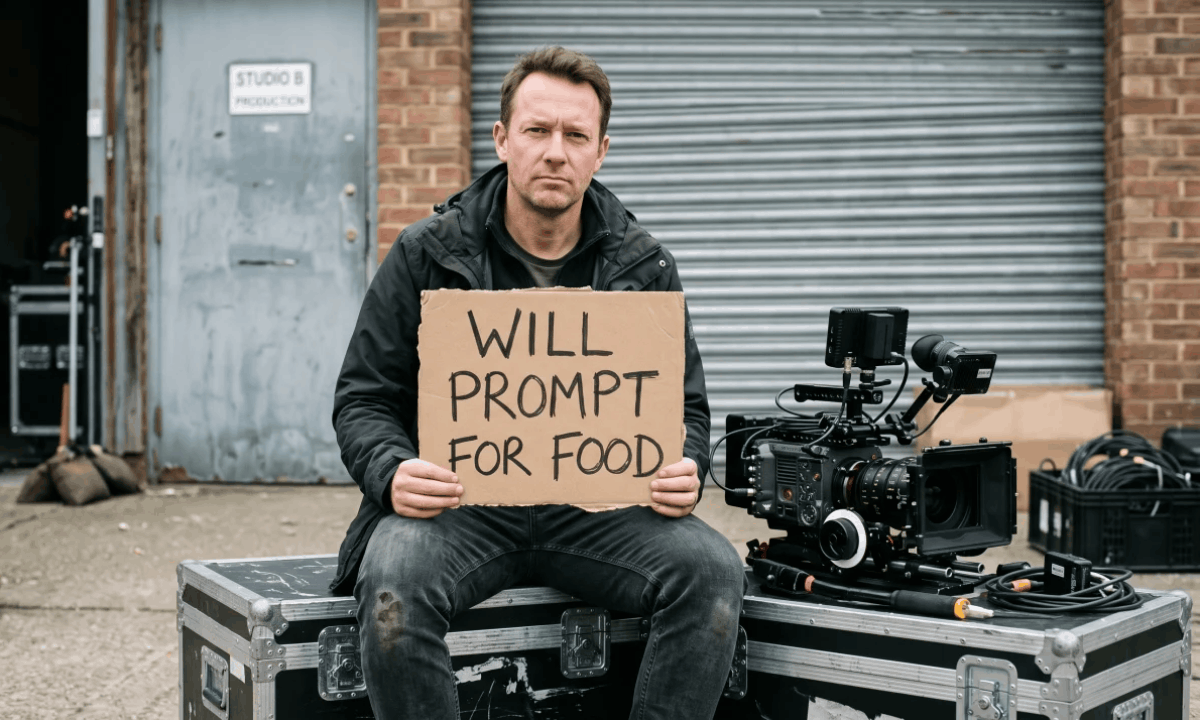
I thought AI wouldn’t replace videographers. I was wrong…
If someone had told me back in late 2018, while I was hanging out of a Toyota Hilux on the Croatian island of Pag, camera in hand, battling the fierce bora wind to capture the perfect shot of a Ferrari hurtling towards me, that a few years later I’d get a similar result by typing prompts from a warm office… I would have told them to F off.
For a long time, I was that guy in the industry defending our craft against the AI onslaught. While we were experimenting with Midjourney at Neuralab and generating visuals left and right, I kept confidently insisting:
Sure, it’s great for generating still images. But there’s no way AI is replacing videographers with years of experience anytime soon.
Early versions of tools like Sora and Google Veo seemed to prove my point. Their output was glitchy: great for memes, useless for a serious eCommerce project.
Today? Today, I’m eating my words. With a little embarrassment, but also a lot of enthusiasm.
Recently, while exploring the possibilities of Prompt Production (PP), I put together an AI video that gave me my absolute favourite shot of the year: a dark workshop, someone lifting the bonnet of a classic car and shining a torch onto the engine. That shot perfectly captures where video production stands right now. We’ve switched on the light in a dark room and realised that the old rules are changing for good.
This is a post-mortem of our transition from traditional production to an AI workflow. A record of what we threw out, what we had to keep and, most importantly, what it means for those of you commissioning video for your website, or delivering it to a client.
Traditional production vs. Prompt Production: the maths is unforgiving
Using two projects for Pagoda Classics, I’ll try to show how my work has changed, what has become more accessible and where I still draw the line.
Pagoda Classics restores rare classic cars. They were the client behind that 2018 shoot on Pag.
What did the old workflow look like in 2018?
Scouting locations along the route through Google Maps. Getting drone permits from Croatia’s State Geodetic Administration and permission from Croatian Roads to film on the road. Three people, five cameras, a drone and a race against eight hours of daylight.
Then came post-production: matching the colour grading across five different cameras, cutting down hours of interviews, animating in After Effects and mixing sound in Audition.
The final tally: 113 production hours. If I were invoicing that today, we’d be talking around €10,000 in labour alone, before equipment rental, travel and permits.
A great end product, but a budget that not every client can afford.
The new workflow in 2026
We needed a video for a case study about the WooCommerce store we’d built for them. This was a shorter format: half the video tells the life story of a Mercedes Pagoda, from 1966 to today, from the car’s perspective. The other half is an animated showcase of the website.
I should acknowledge upfront that these two videos differ in scope and purpose, so their budgets aren’t directly comparable. A project involving location shoots and interviews is a different commission from a shorter video built from generated scenes and interface animation. Still, the comparison clearly shows how much the way I source footage has changed.
The concept for the video was mine. I started with real photographs of the cars from the client’s website. These served as visual references for generation in Higgsfield, using the Seedance 2.5 model, while I used Claude to develop the script and detailed shot instructions.
This is where my videography experience and knowledge of the terminology came in handy. Detailed, well-considered prompts deliver the results you want and save a lot of frustration and money.
I prompted each shot individually rather than generating the entire video in one go, since Seedance has a limit of 30 seconds per generation.
I generated the British-accented narration in Higgsfield’s audio section by simply pasting in the finished script and describing what I wanted. I know, I know… Mercedes is German. But I figured a German accent might make it sound like Arnold Schwarzenegger was doing the talking. Although, now that I’m writing this, given the angle we took with the video, an “I’ll be back” would have worked nicely. 🙂
I animated the online store showcase manually in After Effects, using the Figma design as a reference. So this one project combined generative models, conventional editing, audio processing and manual animation.
That’s why I see the future of production as a mix of techniques chosen to suit each shot. Some things we’ll film, some we’ll generate and some we’ll animate manually. The choice will depend on the result we need, the material available and the time we have.
As for costs, a Higgsfield Plus subscription is $47 a month. On this project, I used around 400 credits across four iterations involving rejected shot generations. The total came to roughly €500.
This workflow allowed me to create scenes that would otherwise have required an elaborate new shoot. Some, such as the factory in Stuttgart, I wouldn’t have been able to film at all. For certain projects, that fundamentally changes the decision about whether a video gets made in the first place.
What remains of the old craft?
1. Quality source material: garbage in, garbage out
Photographs of the actual product, their quality, the camera angle and the visible details all affect what I can ask the model to do. Still, a good reference doesn’t always guarantee an accurate result.
AI loves to hallucinate. I spent quite a while wrestling with the engine under the bonnet: it kept giving me either an engine facing the wrong way or some monstrous contraption that had nothing to do with a Mercedes W113 280SL.
The camera remains an essential tool for capturing high-quality references with accurate colours, textures and dimensions.
2. The purpose of the video
My Pagoda example is an in-house promotional video for an online store case study. A classic car buyer might enjoy a cinematic story, but before buying, they’ll probably also want to see the condition of the actual vehicle. A beautiful generated scene cannot replace footage documenting that specific car.
The same applies to other products. If a customer wants to know whether a jacket is waterproof, an AI scene of someone singing in the rain and channelling Gene Kelly is no proof of waterproofing.
We need a real test or reliable information that the video can clearly explain. Before we start Prompt Production, we need to know what the video is supposed to do. Does it need to grab attention, explain how something works or document a product feature?
3. Style and editing
The new tools change the technical side of the job. But rhythm, pacing, a feel for editing and music, and ultimately taste and style remain human responsibilities.
In all of this, I have an advantage that’s easy to overlook: I’m coming to these tools with twenty years of experience. I know what I want from a shot and why I’m rejecting a particular result.
Someone just starting out can produce an impressive video much faster now. But how will they learn to spot a continuity error, a bad cut or a shot that doesn’t serve the story? How will we teach those fundamentals when tools take over some of the work through which we learned them ourselves? And how will we pass on the standards we use to judge the results?
Quo vadis video?
When you approach an agency with the idea, “Make us an AI video for our new collection,” a useful brief still starts with specifics: your objectives, where the video will appear, accurate references, a list of product details that must remain unchanged and your brand assets.
Approving the video must include comparing it against the original product, because AI can easily alter a texture or a shape. Usage rights and compliance with the EU AI Act also need to be considered.
Neuralab recently became an official partner of OpenAI and Anthropic, giving us more direct access to their infrastructure and better support. That’s one reason I’ve been experimenting more intensively with Prompt Production over the past few months.
What surprises me most right now is how quickly the quality of the finished output is changing in the motion graphics side of video production.
True, I did the motion graphics manually in After Effects this time. But the way Claude Opus 5.5 now understands code and animation makes me think this might have been the last time.
As soon as it came out, I gave it the most pathetic prompt imaginable: “create me a 30 second video that I can put on Instagram reels about our project case X.” Considering how rudimentary the instruction was, the result blew me away.
Experiments like that make me expect rapid changes to some of the routine work in motion design and editing, particularly when we’re producing repeatable formats and lots of variations. Editors and videographers are increasingly becoming curators, rather than people assembling puzzle pieces and waiting for golden hour to capture the perfect shot.
I’d be lying if I said I didn’t miss being out on location. The bora wind, the improvisation, hanging out with the crew and the adrenaline all have a value that no quick render can replace. But clients care about metrics, conversion rates and turnaround times, rather than our nostalgia.
Still, that raises a question in the other direction.
If we can all generate impressive scenes, will footage of a real product, a real workshop and real people become a greater competitive advantage?
For Pagoda, a shot of a craftsperson actually restoring a specific car can offer something a generated scene cannot. It shows who is doing the work, how they do it and which vehicle they’re working on. Will buyers recognise and value that difference? Time will tell.
This project showed me that I can allocate a production budget differently and bring ideas to life that would previously have required another shoot, or simply wouldn’t have been possible within the project’s scope. I want to do that again. I also want to know when real footage is the better choice.
The next step is to measure what that content achieves once it’s published. Producing a video faster and delivering a better business result are two separate things. On this project, I explored the first. The second still needs to be proven.
As for colleagues taking a different approach, the comments are yours. I’m especially interested in concrete examples: what has AI actually sped up for you, where has it slowed you down and what do you still prefer to film?
I’ve already eaten my words once. Give me a good example, and I’m ready to do it again.
Original Netokracija article in Croatian: https://www.netokracija.com/ai-zamijeniti-videografi-snimatelji-248334

A Boletus aficionado who loves to get lost in the woods. He's still holding dearly to his OG Canon 5DmII while claiming that the play button is the apex call-to-action button on the web.